The Voice AI Operating Loop for Recovering Missed Calls
A missed call is not a small service gap. It is a moment when a customer has already shown intent, and every delay creates another path: a competitor, another search result, or no action at all.
Missed-call recovery is an operating loop, not a callback script
Most teams frame missed-call recovery as a speed problem: call back faster. In production, the real question is broader: who called, why they called, whether now is a good time, which qualification fields matter, and what a human seller needs before taking over.
Voice AI should not simply make more calls. Its job is to structure lost intent and move it to the next operating action.
Vapi’s Tools documentation describes how voice assistants can access external data, trigger webhooks, and take actions during a call. OpenAI’s Realtime documentation frames voice interfaces around sessions and events. Together, they point to the same lesson: missed-call recovery needs state design, not just a better script.
The 5-step recovery loop: signal → callback → qualify → CRM → handoff
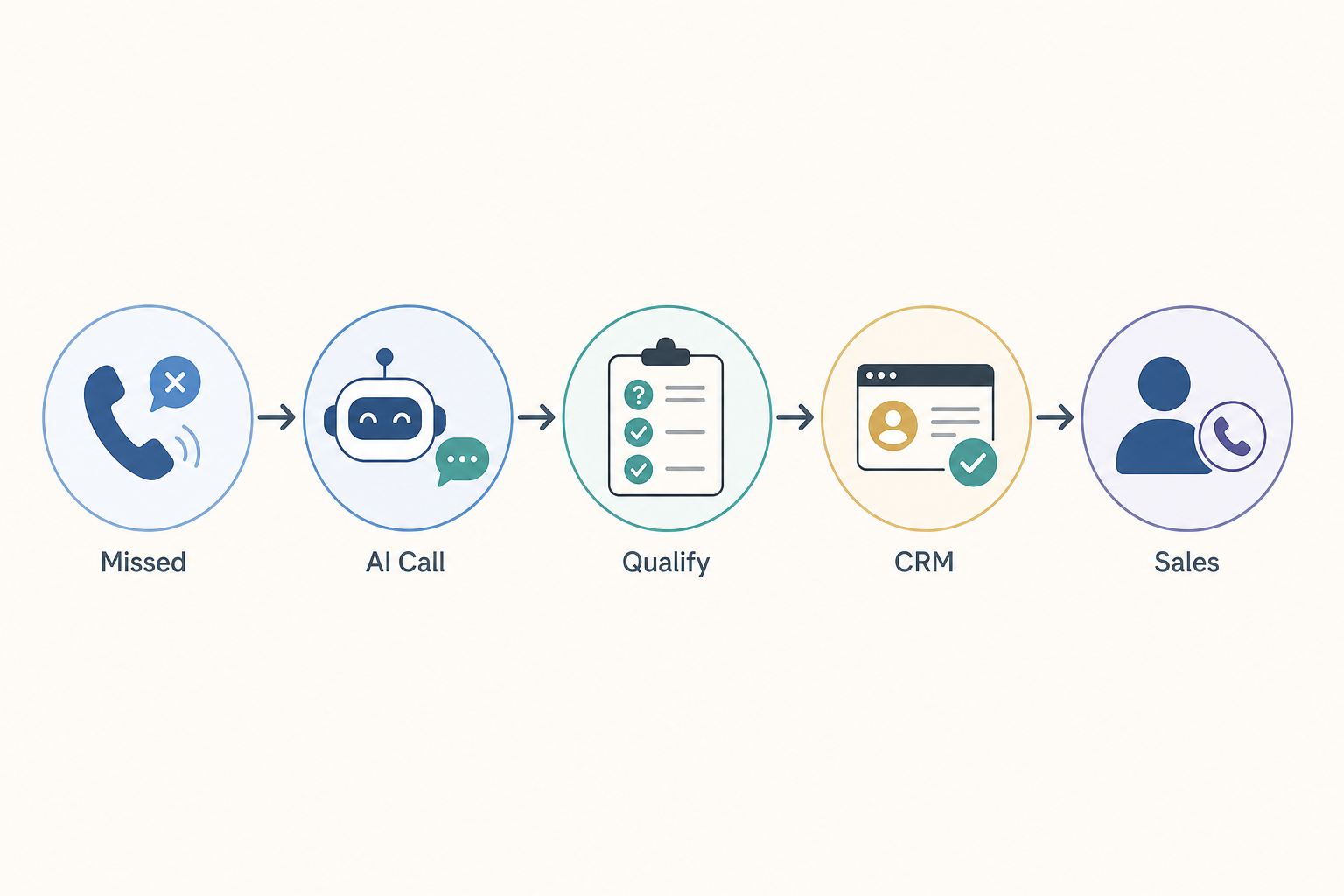
The loop should be short, explicit, and measurable. If the flow feels long, customers experience it as another IVR rather than a helpful callback.
- Signal detection: Treat missed calls, after-hours inquiries, and failed calls after a web-form submission as one intent signal.
- Immediate AI callback: Call first, then confirm the reason for contact and whether the customer can talk now.
- Qualification: Ask only 2–4 essential questions. HubSpot’s sales qualification guidance frames qualification as both finding the right fit and disqualifying the wrong fit early.
- CRM disposition: Do not store only a summary. Store reason code, next action, owner, and urgency.
- Human handoff: Route high-intent customers to sales quickly and move lower-intent customers into Follow-Up Automation.
missed_call_event
  → ai_callback_attempt
  → qualification_fields
  → crm_disposition
  → human_owner_or_fua_queue
CRM needs decision fields, not prettier summaries
Call summaries are readable, but they rarely move a pipeline by themselves. Sales teams need fields that decide the next action.
- reason_code: pricing question, demo request, appointment change, support issue, information request
- urgency: same-day action, this-week action, long-term nurturing
- qualification: buying role, timeline, existing system, budget range captured as confirmed/not confirmed
- next_action: seller callback, material send, booking link, automated follow-up
The direction of Salesforce Agentforce and similar agent platforms shows why this matters: AI agents and CRM workflows are moving closer together. A voice agent that ends the call but does not update pipeline state is not automation; it is a transcript generator.
The CX standard is simple: do not make the customer repeat themselves
The worst missed-call recovery experience is forcing the customer to repeat to a human what they already told the AI. Once that happens, the customer feels that the organization lost context.
BringTalk design lens
Use Context Injection to bring the customer journey into the beginning of the call. Use FUA when the customer is not ready for direct sales handoff but should not be lost. For regulated industries, define Zero Retention and retention boundaries before exposing sensitive call context across tools.
Good Voice AI is not “a machine that sounds human.” It is an organization that remembers what the customer already said.
Six decisions to make before the pilot
Missed-call recovery is easier to pilot when operations are agreed before the first demo. Decide these six items in writing.
- Which events count as recovery triggers
- How quickly and how many times the AI should call back
- Which fallback line to use when the customer is busy or declines
- How many qualification questions are allowed
- Which CRM fields and reason codes are mandatory
- Who owns the handoff SLA after the AI call
Once these decisions are fixed, Voice AI becomes part of the revenue operating system rather than a response-rate tool. The outcome depends less on one model feature and more on how tightly the call, data, and human handoff are connected.
Key point: missed-call recovery is not callback automation. It is a closed operating loop that reaches CRM and human ownership. If the loop does not close, call volume may rise while pipeline stays flat.
Sources: Vapi Tools docs, OpenAI Realtime docs, HubSpot Sales Qualification guide, Salesforce Agentforce page.