Voice AI Disaster Recovery: Five Decisions Before Calls Break
Twilio’s June 14, 2026 article on cross-region voice disaster recovery points to a practical Voice AI problem: production teams should not only ask whether an agent speaks well, but how the call path recovers when the voice stack becomes unstable.
Recovery Is a Customer Experience Problem
Voice AI failures feel faster than web-chat failures. If a call pauses for several seconds, the customer does not think “the system is processing”; they think the call has died.
The goal of Voice AI recovery is not perfect zero-downtime. It is preventing the customer from repeating the same context twice.
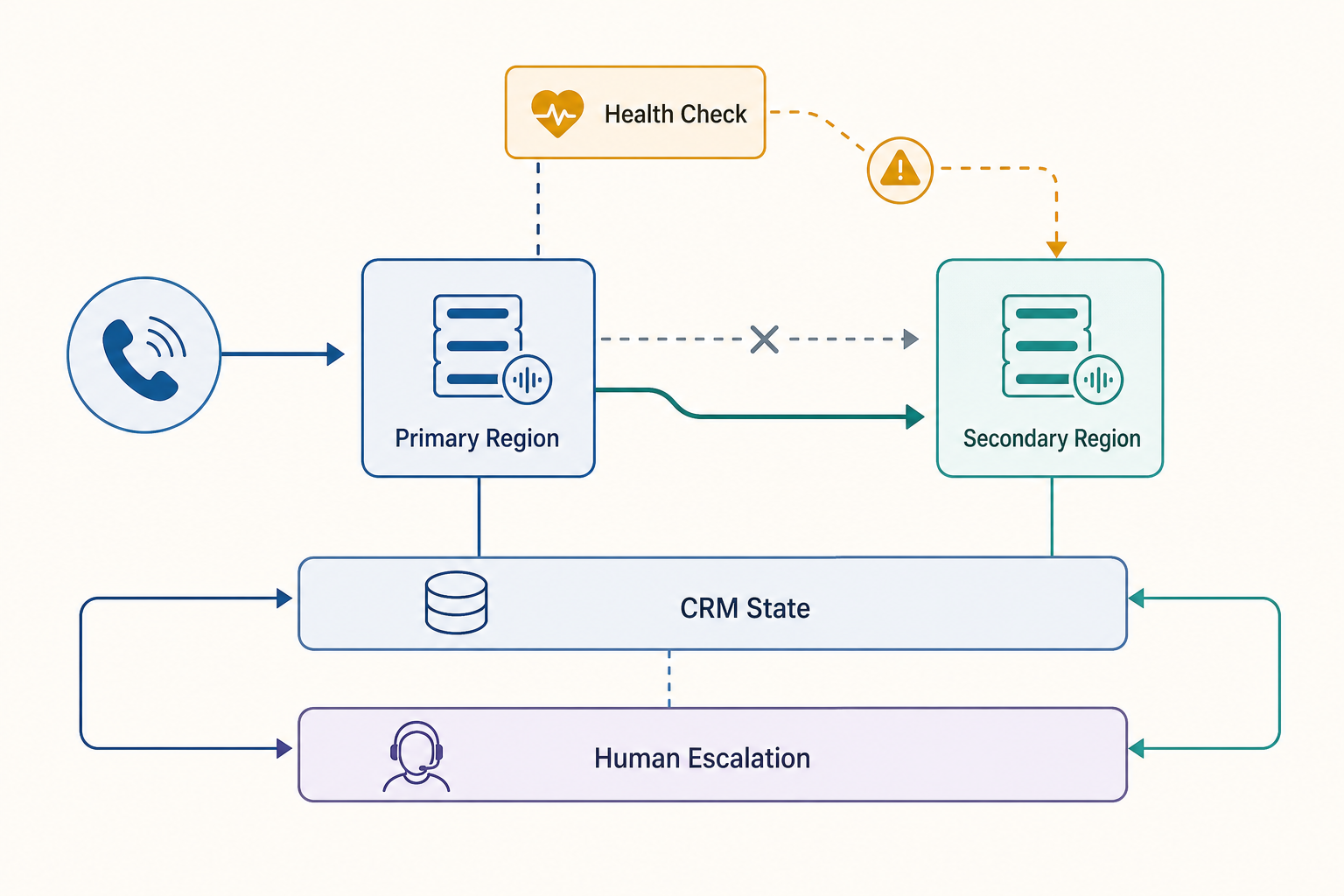
Twilio frames resilience at the voice-call and regional level. For a Voice AI operator, that recovery model also needs to include STT, LLM routing, TTS, CRM lookup, and human escalation.
Five Decisions to Make Before Go-Live
Disaster recovery should be an operating decision before launch, not a future automation backlog.
- Primary and secondary regions: where calls start, and where they move when the primary path fails.
- Health-check signals: separating SIP response, media path, STT/TTS latency, and LLM errors.
- State handoff scope: which customer identifier, last intent, CRM result, and interaction summary can survive a route change.
- Human escalation trigger: when a live agent is safer than automatic recovery.
- Post-incident evidence: whether the team reviews only transcripts, or also route-change logs and cause tags.
Call State Should Be Designed for Resume, Not Storage
The missing piece in many DR plans is call state. If the region switch works but the customer has to repeat their name, issue, or reservation number, the operation has not really recovered.
Example recovery priority
1. Keep the call alive or redial quickly
2. Preserve customer identity and latest intent
3. Re-query CRM, booking, or order state
4. Avoid repeated instructions
5. Hand a summary to a human agent
Zero Retention needs to be part of this design. The architecture should avoid storing PII on external LLM servers while keeping the minimum internal session state needed to resume the conversation.
Fallback and Disaster Recovery Are Not the Same
Fallback recovers the conversation when understanding fails. Disaster recovery recovers the call when a region, provider, media path, or data dependency fails.
- Fallback: re-confirm intent, rephrase guidance, route to an agent.
- DR: fail over regions, change SIP path, reconnect media streams, re-query state.
- Shared rule: do not make the customer repeat the same context.
This means the Voice AI operations dashboard should separate intent failures from infrastructure failures. The next action is different when “handoff failed” means LLM misclassification versus media-path instability versus CRM timeout.
A BringTalk Operating Checklist
Enterprise Voice AI recovery should appear in the buying conversation, not only in an incident review. In finance, automotive, appointment, and customer-support workflows, recovery design becomes part of quality and risk review.
Before Deployment
- If failure happens, does the customer hear silence or a controlled message?
- After region failover, does customer context survive?
- Does the human agent receive the reason for escalation?
- Can the operations team classify failed calls by cause after the incident?
After Deployment
- Did detection happen before customer complaints?
- Were retry and escalation thresholds too aggressive or too slow?
- Which manual recovery step should be automated before the next incident?
Bottom line: Voice AI DR is not a server redundancy document. It is an operating model for preserving conversation context when the stack is under stress.
Sources: Twilio, “Cross-Region Voice Disaster Recovery” (2026-06-14); OpenAI, “Predicting model behavior before release by simulating deployment” (2026-06-16).