Salesforce’s Fin Acquisition Signals Customer Agents Are Becoming an Operating Layer
Salesforce announced a definitive agreement to acquire Fin on June 15, 2026. In Salesforce’s own release, the transaction is valued at approximately $3.6 billion, and Fin’s AI Agent is described as resolving customer queries across live chat, email, WhatsApp, SMS, phone, and Slack.
This is not just another customer-support AI headline. It is a signal that enterprise customer agents are moving from channel-specific bots toward an operating layer that connects CRM events, voice escalation, human handoff, and audit records.
1. The Important Shift Is Not Channel Count
Salesforce’s release emphasizes Fin’s ability to work across multiple digital channels and phone. The strategic question is not simply where the agent can answer. It is where customer state is decided, escalated, and recorded.
Customer-agent quality is no longer only about response generation. The stronger buying criterion is the operating boundary: where the agent starts, when it stops, who takes over, and what evidence remains.
That changes enterprise evaluation. The question is no longer “Do we have a chatbot?” It becomes: “When a CRM event arrives, which customer should AI handle first, when should it escalate to Voice AI or a human, and where is that decision logged?”
2. Phone Is the Clue Voice AI Teams Should Watch
The notable word in the Salesforce-Fin announcement is phone. Many customer journeys begin in chat, but contracts, cancellations, complaints, billing, and scheduling often move back to voice when stakes increase.
Voice AI should therefore be designed as one step in a customer-service operating loop, not as a standalone call bot. CRM events and voice escalation need to sit inside the same loop.
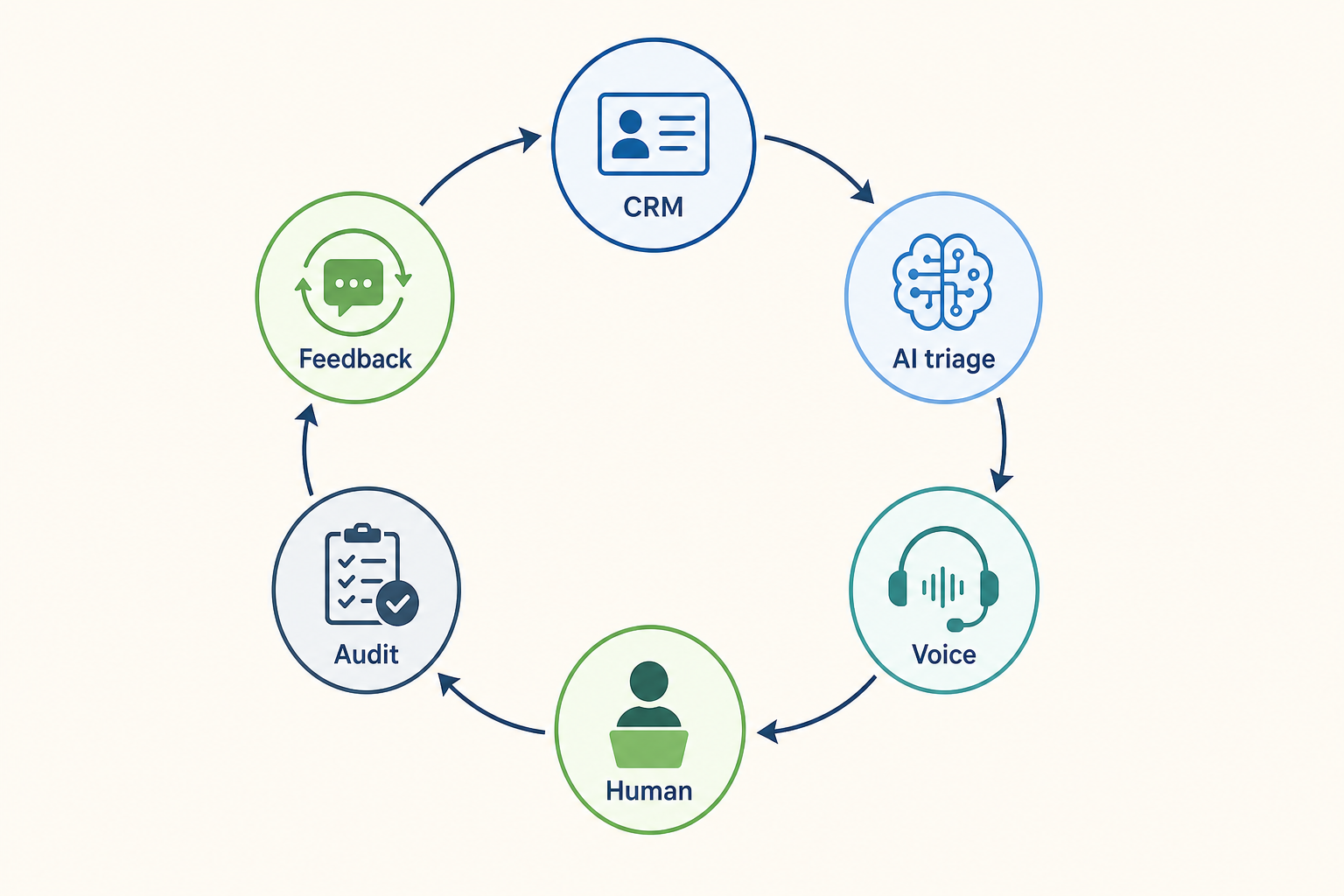
CRM event → AI triage → voice escalation → human handoff → audit log → feedback
In this structure, STT/TTS quality matters, but so do handoff reasons, customer disclosure, conversation summaries, and next-action storage. BringTalk’s FUA — Follow-Up Automation — becomes valuable at this layer: the system turns unresolved or missed interactions into the next voice, message, or human action.
3. Five Questions Buyers Should Ask Now
The Salesforce-Fin announcement gives enterprise teams a practical reason to look beyond demos. If customer data and service workflows are fragmented across systems, the buying checklist should start with operations.
- Trigger: Which CRM events start the AI interaction?
- Escalation: What moves a case from chat to phone or a human agent?
- Context Injection: Which customer-journey fields are passed to the AI, and which are excluded?
- Audit Record: Where are AI decisions, disclosures, and handoff reasons stored?
- Follow-up: How are missed, unresolved, or abandoned cases recovered?
If the vendor cannot answer these questions, the AI may look impressive in a demo but push exceptions back to human operators in production.
4. The Korea/APAC Implication
Many Korea and APAC enterprises operate with separate CRM, call-center console, messaging, recording, and quality-management systems. In that environment, “replace everything with one large platform” is rarely the first practical step.
A more realistic path is to define the operating boundary first:
- Separate high-intent leads from repetitive service requests.
- Define when a case must escalate to voice.
- Decide privacy, disclosure, and retention rules before the AI call.
- Standardize the minimum summary fields required for human handoff.
BringTalk’s view is that LQA and FUA must connect. Lead Qualification Automation identifies intent; Follow-Up Automation recovers the customers who did not complete the journey; the CRM record closes the loop. That is how Voice AI becomes an operating system rather than a call automation feature.
5. The Buying Criterion Is the Loop
The acquisition news suggests that the customer-agent market is no longer explained by model quality alone. Enterprise buyers should ask a more operational question.
What event starts the agent, what evidence lets it stop, who receives the handoff, and where is the record kept?
Clear answers to those questions move Voice AI from pilot theater to production operations. Salesforce’s Fin acquisition is market news, but the operating lesson is more practical: customer agents should not be purchased as isolated channel features. They should be designed as the loop connecting CRM, voice, human teams, and auditability.