Private Voice AI Makes Deployment Boundaries the New Buying Criterion
The enterprise Voice AI question is changing. After “does it work?”, regulated buyers now ask: “Where do audio, transcripts, and inference actually run?”
Why Private Voice AI Is Back on the Table
Recent coverage reported that Deepgram is bringing private/on-premises Voice AI deployments to regulated industries with Fortanix and NVIDIA. The important signal is not just another speech model update. It is the return of deployment boundary as a board-level buying criterion.
Voice AI security is moving from “we do not store recordings” to “we can prove the processing boundary and audit trail.”
Financial services, healthcare, public sector, and large contact centers handle identity data and sensitive conversation in the same call. That makes data flow, retention, fallback, and auditability as important as model accuracy.
Deployment Is a Boundary Choice
Voice AI is not one deployment model. It is a boundary decision across audio, transcript, inference, and logs.
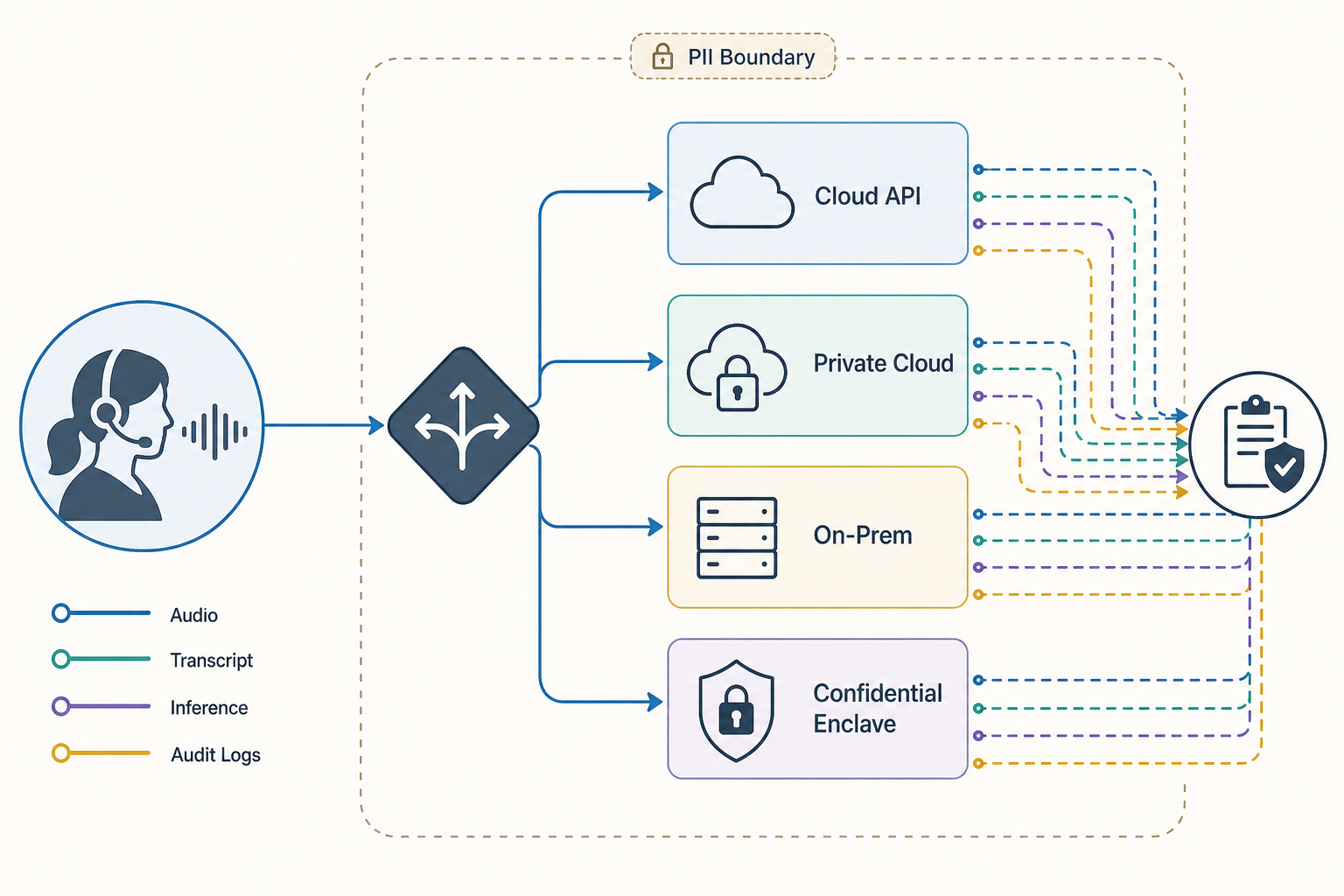
Deployment choice
1. Public cloud API      : fastest pilot, lowest operations burden
2. Private cloud/VPC     : stronger network and access control
3. On-premises           : data location and operational control first
4. Confidential enclave  : stronger protection for sensitive inference workloads
None of these is universally “best.” The right architecture depends on call type, data sensitivity, latency budget, and the buyer’s security review path.
Five Questions Regulated Buyers Should Ask First
Before model benchmarks, regulated teams need operating answers.
- Where are raw audio and transcripts generated, transmitted, and deleted?
- Does any PII reach an external LLM or inference layer?
- When the agent fails, what happens first: human transfer, IVR fallback, or retry?
- Are disclosure and consent events linked to the call record?
- Can the audit log reconstruct who processed what, when, and under which policy?
If these questions are unanswered, a successful pilot can still fail production approval. For Korean and APAC enterprises, the review usually spans privacy, delegated processing, cross-border transfer, and recording retention at the same time.
BringTalk POV: Zero Retention Is Necessary, Not Sufficient
BringTalk uses Zero Retention to mean that PII is not stored on external LLM servers. For enterprise operations, that principle needs a wider control plane.
- Context Injection: CRM and journey context should be injected only when needed and only at minimum scope.
- PII boundary: identifiers need different masking policies across STT, LLM, and logs.
- Fallback evidence: silence, recognition errors, and model failures must leave recoverable traces.
- Approval packet: security and legal teams need a data-flow diagram, retention policy, and audit examples.
Private Voice AI is therefore not just infrastructure. It is part of the procurement evidence package.
The Next Pilot Should Test Boundaries, Not Just Features
A 100-call accuracy pilot is useful, but it does not explain production risk. The better pilot tests the operating boundary.
Recommended pilot artifacts
- Data classification by call type
- STT → LLM → TTS → human handoff flow
- PII masking and deletion policy
- Failure/fallback log samples
- One-page operating summary for security and legal review
The next regulated Voice AI advantage will come from teams that can explain data boundaries as clearly as they demo natural conversation.
Sources checked: BusinessWire/Google News coverage of Deepgram private Voice AI with Fortanix Confidential AI and NVIDIA Confidential Computing (2026-06-01), rAVe [PUBS] follow-up coverage (2026-06-08), Crypto Briefing coverage (2026-06-09).