How Voice AI Handles Interruptions: The Turn-Taking Problem
People prepare their next sentence before the other person finishes. One study of ten languages found that the gap between speakers averages just ~200 milliseconds (Stivers et al., PNAS 2009). Most of the moments when voice AI feels unnatural come down to missing that short rhythm.
200 Milliseconds: Conversation's Invisible Rule
Human conversation leaves almost no silence. We predict where a sentence will end and ready our reply before it does. When that prediction misfires, we immediately sense a "broken" exchange.
Naturalness is decided by timing before it is decided by accuracy.
Voice AI is judged the same way. A correct answer half a second late reads as hesitation; too fast reads as cutting someone off.
Reading Silence: VAD and Endpointing
To know when it's "my turn," the AI has to tell a finished sentence apart from a mid-thought pause. That job belongs to VAD (Voice Activity Detection) and endpointing. VAD separates speech from non-speech; endpointing decides whether the silence marks the end of a turn.
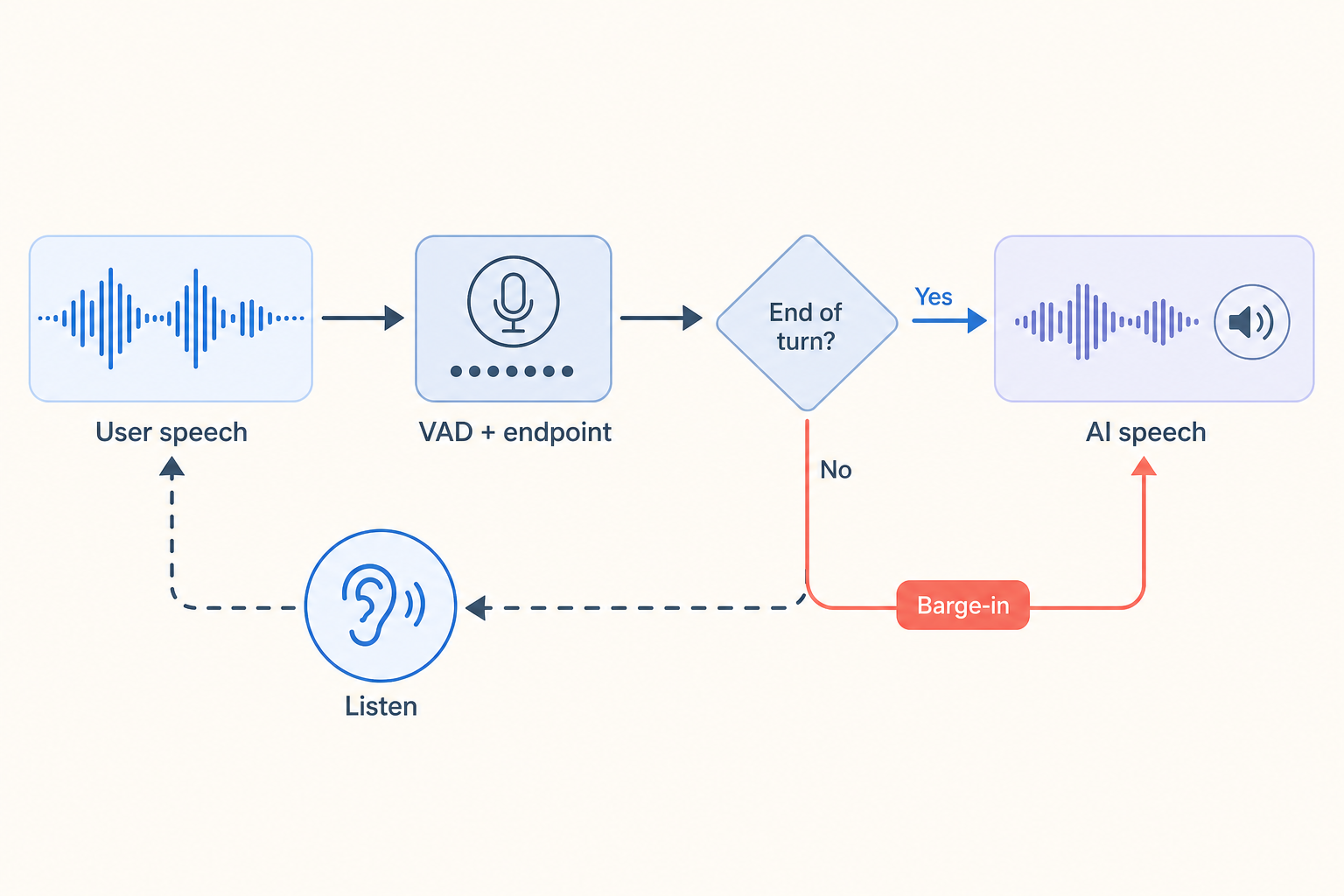
As the flow above shows, user speech only advances to an AI response once it passes the VAD and endpointing gate as an end-of-turn.
The Order of Barge-In Handling
People interrupt freely while the other side is still talking. If voice AI doesn't allow it, users must wait through long prompts and the call drags. Barge-in handling usually follows this order:
- Keep listening to input audio even while the AI is speaking
- Halt the in-progress TTS the moment user speech is detected again
- Re-recognize the user while preserving context up to the cut-off point
- Regenerate the response around the new intent
Balancing Haste and Lag
Endpointing is a trade-off with no single right answer. An aggressive threshold responds faster but clips users whenever they pause. A conservative one cuts down on false interruptions but makes every turn sluggish.
- Aggressive endpointing — fast replies, frequent clipping
- Conservative endpointing — stable listening, slow reactions
- Context-aware tuning — adjust the threshold by question type and utterance length
In production, tuning this balance per call situation beats locking in one fixed value.
Natural Turn-Taking Drives Call Outcomes
Turn-taking isn't only a usability concern — it ties directly to results. In the Golden Time right after a lead is captured, an AI that converses smoothly keeps customers on the line. BringTalk designs endpointing and barge-in policies around each call's purpose in its LQA (Lead Qualification Automation) scenarios, so the interaction stays a conversation rather than a broadcast.
Key point: human turn transitions average ~200 milliseconds (Stivers et al., 2009). A voice AI's naturalness is decided first by the timing of endpointing and barge-in — not by the content of the reply.