Voice AI Production Readiness: Five Gates Before Go-Live
A Voice AI pilot that works in a controlled demo is not automatically ready for production. The gap usually appears in the first operating week: CRM context is incomplete, human handoff is unclear, evaluation criteria are loose, and monitoring stops at transcripts.
Pilot Success Is Only the Starting Point
Pilots run on narrow scenarios, clean test data, and short feedback loops. Production calls include edge cases, customer emotion, network quality, internal policy, and agent handoff at the same time.
The production standard is not “the agent can talk.” It is “the team can recover when the agent fails.”
Realtime voice infrastructure such as OpenAI Realtime API, LiveKit Agents, and Twilio ConversationRelay has made speech input, voice output, and telephony integration more accessible. The bottleneck is shifting from model access to operating design: what context enters the call, when the agent stops, and who owns the follow-up.
Use Five Gates Before Going Live
Before launch, teams need operating gates more than a feature checklist. If these five gates are missing, there is still a gap between “the technology works” and “the business can trust it.”
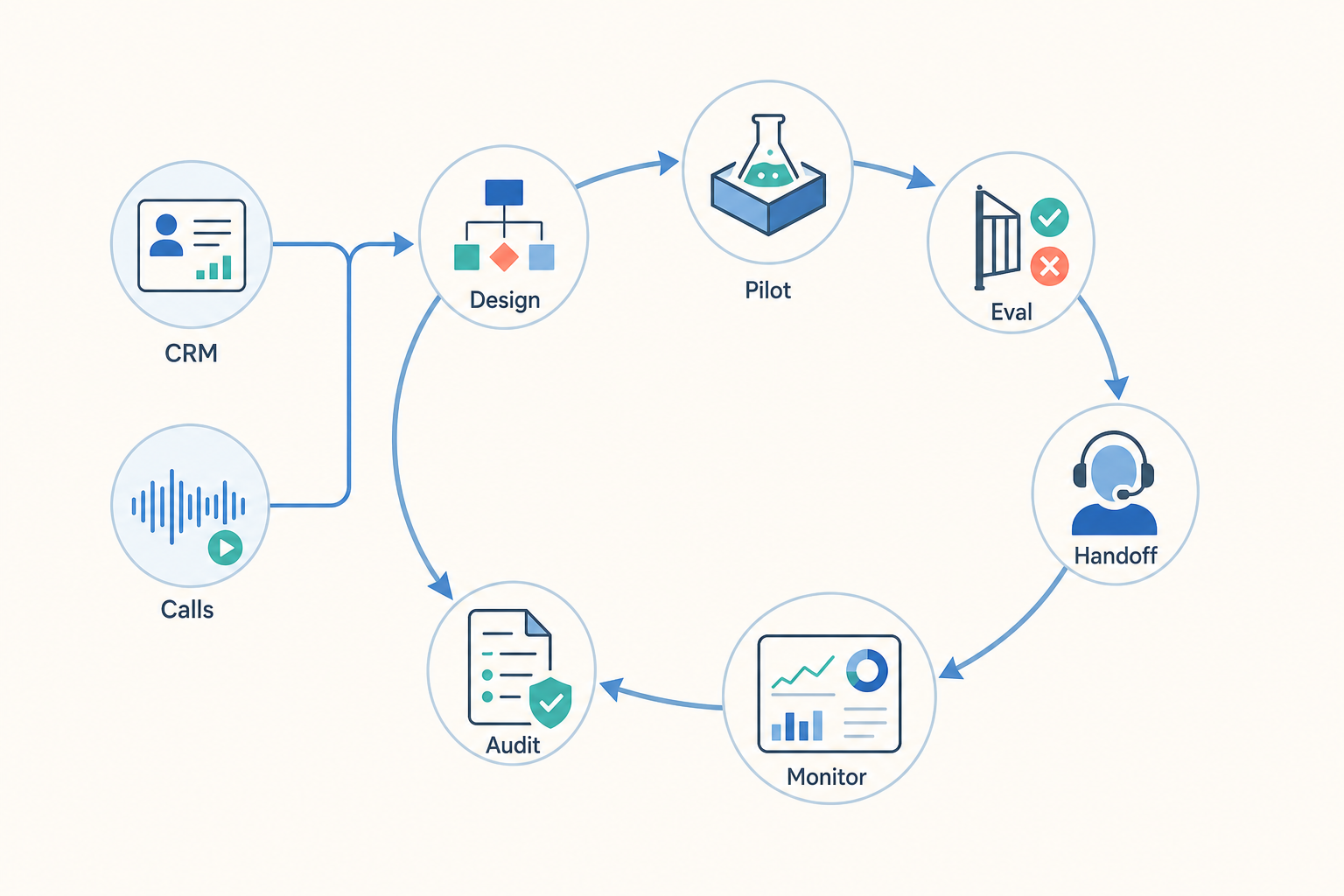
- Context gate — only the CRM fields, lead source, and prior interaction data required for the call are injected.
- Conversation gate — recovery paths exist for barge-in, silence, repeated questions, and low STT confidence.
- Handoff gate — the team knows when to route to a human, what summary to send, and what SLA applies.
- Evaluation gate — success labels, sampling rules, and prohibited utterances are tracked as operating metrics.
- Compliance gate — disclosure, consent, retention, deletion, and audit logs are recorded.
CRM Integration Means Less Context, More Precision
A common early mistake is giving the agent every CRM field available. Voice AI is a realtime conversation system; more irrelevant context can increase latency, create false personalization, and raise policy risk.
Production context budget
- Must-have: name, inquiry source, product/service interest, consent status
- Conditional: previous call summary, appointment window, assigned sales owner
- Never-by-default: sensitive identifiers, raw private notes, unsupported pricing assumptions
BringTalk treats Context Injection as an operating control, not just a personalization feature. The same design document should define what the agent must know and what it must never say.
Without Handoff and Monitoring, Automation Becomes Risk
The goal should not be for the voice agent to finish every call. In enterprise settings, customer objections, payment or contract issues, sensitive information, and low-confidence moments need a designed human handoff.
- Handoff rules should separate intent, sentiment, repeated failure count, and customer tier.
- Do not stop at transcripts; track outcome, escalation reason, latency, and tool failure.
- In operating reviews, ask “which failures repeated?” before “how many calls were handled?”
The LiveKit and Twilio documentation both frame realtime voice agents as systems that combine telephony, media streams, and application logic. Observability should follow the full call path, not just the final transcript.
Approval Should Be Based on Repeatable Operations
A production readiness review should not be a one-time meeting right before launch. For Sales and CS teams, the key question is not whether the agent answered well, but whether the correct next action was created.
Minimum Operating Artifacts BringTalk Recommends
- 3 representative call flows and 5 exception flows
- Human handoff summary template
- Prohibited utterance and compliance checklist
- Sampling-based QA sheet
- Weekly review log for quality and incident patterns
The core point: production Voice AI is not a model choice. It is an operating system across CRM context, handoff, evaluation, and compliance.