Voice AI Transparency Now Needs an Audit Trail

Voice AI is moving from “Can it sound natural?” to “Can we prove what was disclosed, what data was used, and what was retained?” On June 11, 2026, OpenAI said in its RSS announcement that it supports Europe’s AI content transparency Code of Practice and provenance standards. The EU AI Act has already established a risk-based AI regulatory framework. For enterprise voice teams, the practical artifact to build now is a disclosure audit trail.
Transparency Is Operational Evidence, Not UX Copy
Saying “this is an AI assistant” once is not enough for enterprise operations. Teams need to record when the notice was played, whether the customer continued, when human handoff was triggered, and how transcript retention was handled.
The real question is not “Did we disclose?” It is “Can disclosure, consent, retention, and review be reproduced from the same operating system?”
The external direction is becoming clearer. The EU AI Act overview describes the Act as the first comprehensive legal framework for AI, organized around risk. OpenAI’s June 11, 2026 RSS announcement also stated support for the EU AI content transparency Code of Practice and provenance standards.
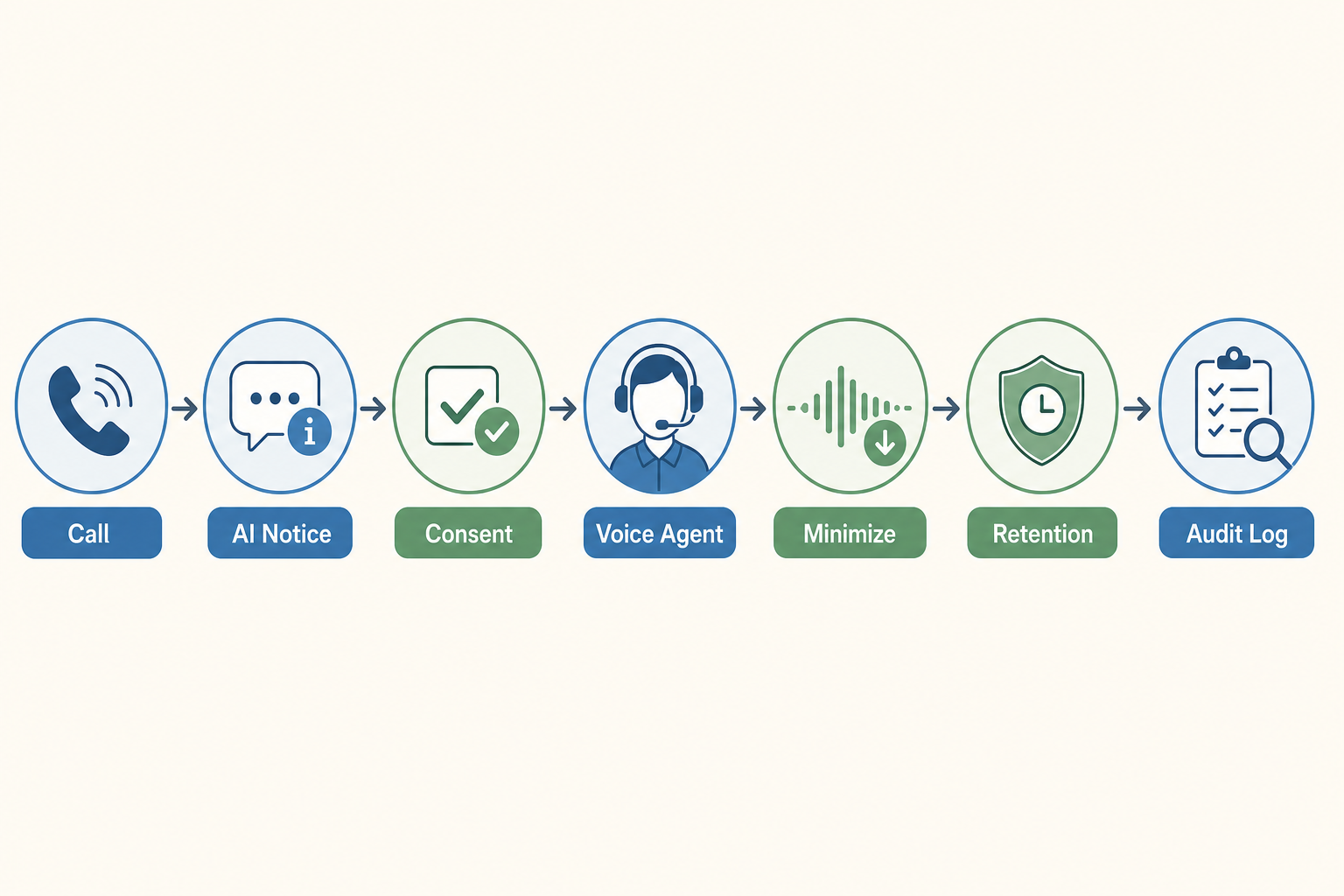
Voice AI Needs Five Minimum Events
Voice AI should be logged more carefully than a standard chatbot. Calls happen in real time, and customers rely on spoken notice rather than a visible policy screen.
Event                         Why it matters
AI disclosure played          Confirms the customer was told it was AI
Consent / continue signal     Captures continuation or drop-off point
Human handoff trigger         Proves escalation rules for sensitive cases
Transcript minimization       Checks whether only necessary data remained
Retention / deletion action   Audits storage period and deletion execution
These five events let compliance, QA, and customer success reconstruct the same call in the same way.
Korea and APAC Teams Will Meet Procurement Before Regulation
Even when a Korean company is not directly exposed to EU enforcement, enterprise procurement and security reviews already ask similar questions.
- When do you tell the customer they are speaking with AI?
- Where are recordings and transcripts stored, and for how long?
- What retention policy applies when PII reaches an external LLM?
- How does the system hand off sensitive, angry, or uncertain calls to humans?
- Can the process be proven across operating logs, not just a sample demo?
If a vendor cannot answer these questions, a strong model demo may still fail to convert into a production contract. In finance, automotive, rental, and healthcare scheduling, operating evidence becomes a faster bottleneck than speech quality.
BringTalk POV: Zero Retention Is Not a Standalone Feature
BringTalk’s Zero Retention principle is not just a checkbox that says PII is not stored on external LLM servers. In real procurement, disclosure, context injection, transcript policy, and human fallback are reviewed as one control surface.
- Disclosure: Notify the caller before authentication or at the first agent turn.
- Context Injection: Pass only the minimum customer journey data needed for the call.
- Zero Retention: Configure external models so PII is not retained on their servers.
- Fallback: Route complaints, sensitive data, and uncertainty to human teams.
- Audit Log: Keep the above events at the call level.
The Test of a Good Design
A good Voice AI system must satisfy two tests at once: it should feel natural to the customer, and it should remain explainable to a reviewer after the call. Passing only one test is not enough for production.
Three Actions for the Next Pilot
- Standardize the disclosure line. Agree on a default sentence with legal, security, and CX before optimizing brand tone.
- Define the event schema. Store call ID, disclosure timestamp, handoff reason, retention policy, and deletion state in one structure.
- Add compliance replay to QA. Review failed, angry, and escalated calls—not only successful ones—to confirm evidence exists.
In 2026, Voice AI competitiveness is not only response speed. Enterprise buyers will favor teams that disclose AI clearly, use only necessary data, and leave an explainable operating trail.